Design record · not part of the site
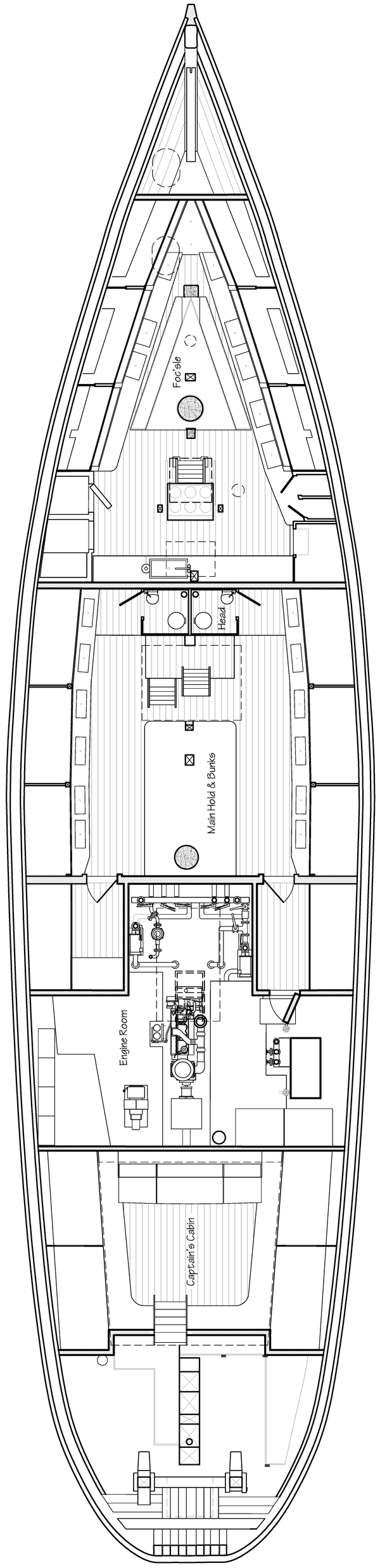
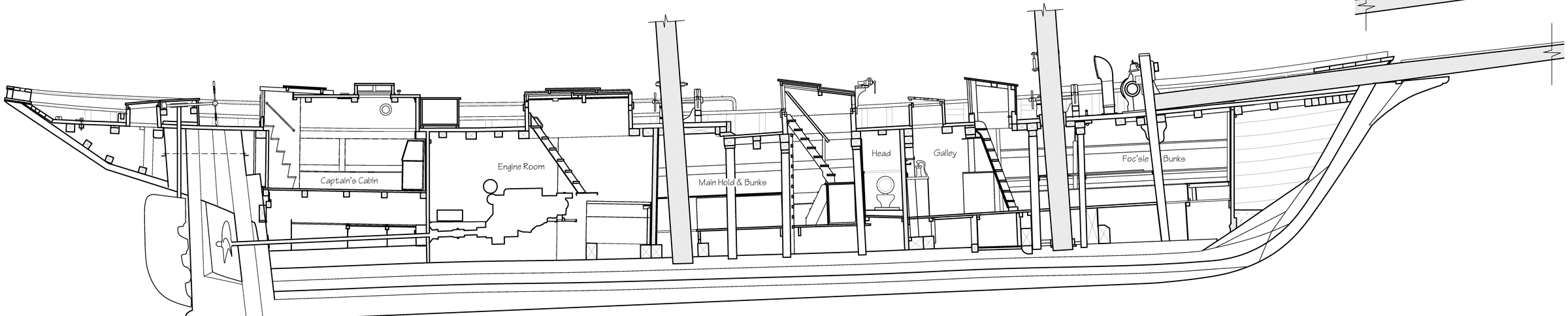
The two views on HAER sheet 4, cut into separate assets and put where each one's
proportions want to go: the deck plan turned bow-up down the right column,
the inboard profile level across the foot. Mock of
/architecture; nothing installed.
Cut rather than CSS-cropped from one sheet, for three reasons that all matter at page
load: the rail pulls 212 kB instead of dragging in 555 kB of sheet to show
a quarter of it; the rotation is baked in, so there is no transform for a blend to get
trapped inside; and each asset carries intrinsic dimensions, so the column and the band
reserve their space before the image arrives — no layout shift.
What to look for
The rail is sticky, so the vessel is still there at the bottom of the
reading. It holds still while the text moves, which is the opposite of a parallax trick —
nothing animates, and there is nothing here for reduced-motion to switch off.
The rail dies below 900px and is removed rather than shrunk. A 1:4 drawing
at phone width is 1300px of column with nothing beside it. The band survives every width,
because a band is the one shape that does not care how narrow the page gets — which is an
argument for the band being the safer of the two commitments.
The band becomes a silhouette at phone width, and this is the one thing
the arrangement does not solve. At 390px the profile is about 300px across: the vessel's
line survives, every internal detail does not. It still works as a closing device — the
detail is not what a band above a footer is for — but nobody should install it believing
a reader on a phone can see the galley. The alternative is a horizontally scrolling band,
which is worse: a footer is the wrong place to ask someone to drag.
Both drawings are the same vessel, which is the quiet part. The band shows
her cut lengthways and the rail shows the same hull from above; a reader who notices that
the forecastle is forward in both has been told something true about drawings, on a page
whose subject is drawing systems before claiming them.