Design record · not part of the site
A surveyed plate, treated four ways
The drawn-from-scratch figure will not reach the density of a real measured survey, so this tries the other route: a public-domain plate from the Historic American Engineering Record, and the question of whether it can sit on ink-on-linen without fighting it.
Everything below is CSS on one unmodified JPEG. No image editor touched it. The crop, the rotation and the colour treatment are all rules that can be deleted, and the same file would render normally anywhere else. That is what makes the decision reversible.
These come from the master. The Library's service copy is 1024px and turns to mush at any useful size; the master is a 14400 × 9600 bilevel TIFF of about 518 kB, and the plates below are 4800px derivatives of it. At that size the handwritten annotations are readable — Captain's Cabin, Main Hold & Pantry — and individual fastenings survive. That is the density a generated hull cannot reach, and it is the whole reason for taking this route.
01 · The sheet, untreated
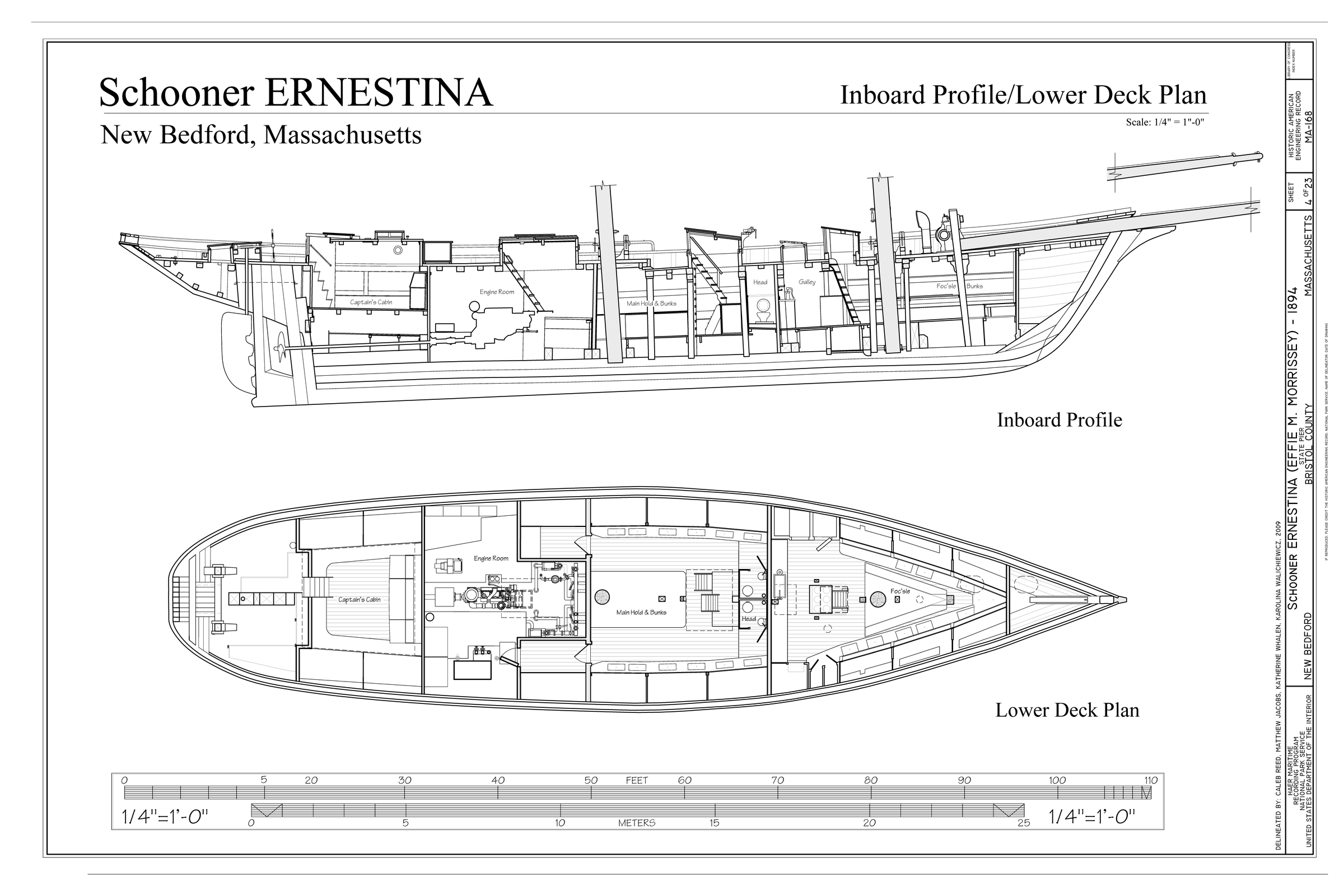
The problem, reproduced: a white ground painted back behind the same file. A scan
arrives as black line on white, and against linen that reads as a photograph of a
drawing rather than as a drawing. The black is also harder than anything else on the
site — the body type is #141b1d and the rules are 35% of it.
02 · Treated for the surface
The white is gone from the file, not hidden. Because the master is
bilevel, the conversion turns its white into transparency and keeps the ink as alpha —
so the plate sits on linen because there is nothing behind the lines to sit on top of.
Opacity at 86% lands the ink near #201f1d, the page's own weight.
An earlier version of this record did it with mix-blend-mode: multiply,
which worked everywhere except inside the rotated rail: transform opens a
stacking context and a blend cannot reach outside one, so the rail kept a white ground.
Transparency has no blend to be trapped, so that bug cannot return in some future
arrangement either. Costing nothing was the deciding argument — lossless WebP with an
alpha channel came out the same size as the flat greyscale.
03 · Cropped to the profile
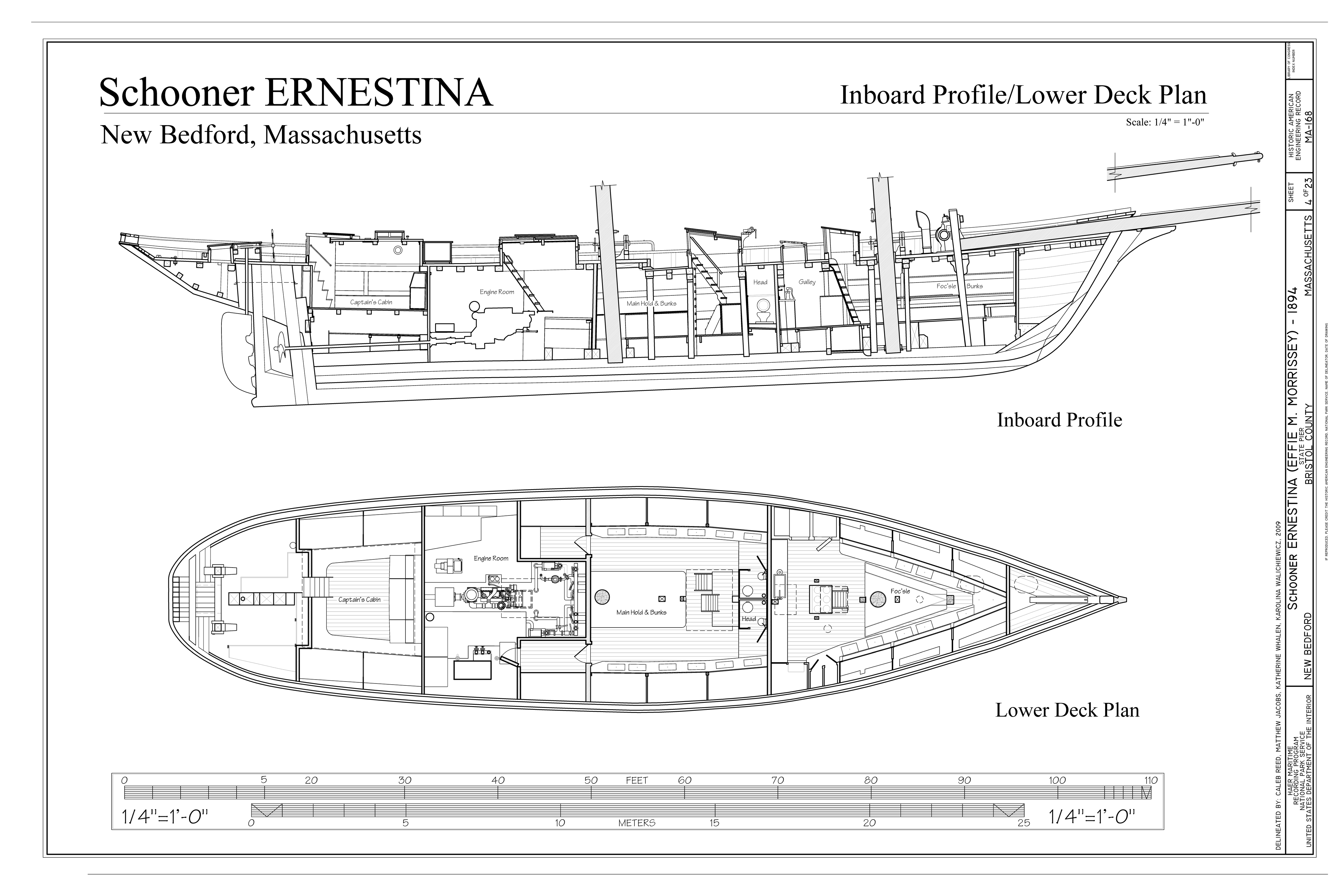
A window with overflow: hidden and the plate shifted inside it. The offsets
are fractions of the sheet rather than pixels, so swapping in the 14400px master changes
nothing but the sharpness.
04 · As a right-hand rail
Begin with the system, not the spectacle.
This section is designed for engineers who are interested in AI but unwilling to suspend the disciplines they already trust.
Mock text, standing in for the architecture index, so the rail can be judged beside a column of prose rather than on its own. The drawing runs the full height of the column and is cut by it at both ends, the way a sheet larger than the desk is.
The rotation happens inside a fixed box, so the page never has to know its contents are sideways: the column reserves its width, and there is no layout shift whatever the drawing does.
This is the trade, visible at last. At 300px the survey's annotation is gone — not illegible, gone. What the rail keeps is the vessel's line and the density of the framing, which is texture rather than information. If the labels are the point, the plate wants to run full width; if the bounding element is the point, the rail wants a drawing that never had labels.
Sheet 9, for comparison
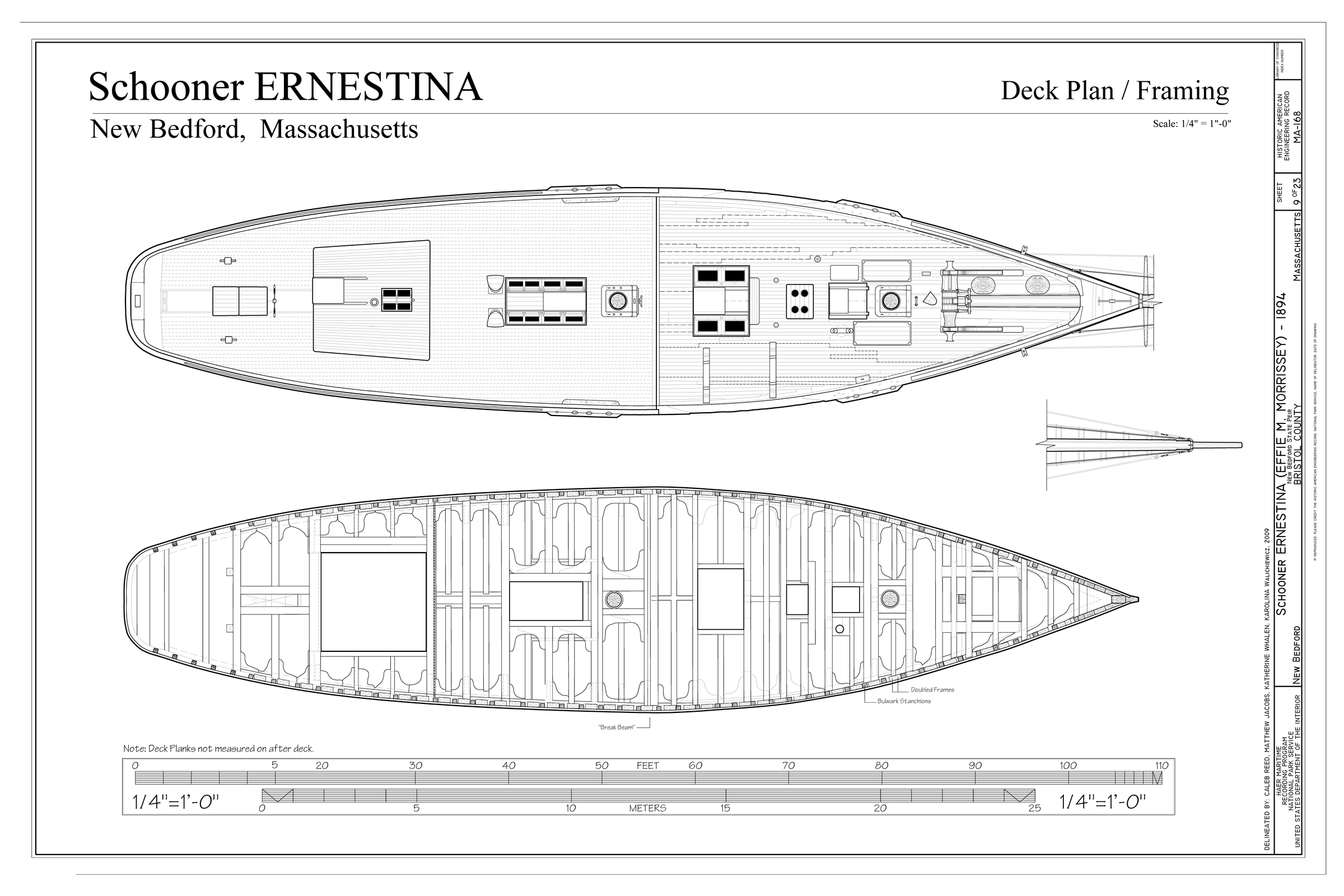
The framing plan is arguably the better drawing of the two: every frame individually measured, which is exactly the density that cannot be reached by generating a hull from parameters. It is also the one that survives shrinking best, because its subject is repetition rather than annotation.
- Drawing
- Historic American Engineering Record, HAER MA-168. Schooner Ernestina (ex Effie M. Morrissey, 1894), New Bedford Whaling National Historical Park State Pier, New Bedford, Bristol County, Massachusetts. Sheet 4 of 23, “Inboard Profile / Lower Deck Plan”, and sheet 9 of 23, “Deck Plan / Framing”. Delineated 2009.
- Held by
- Library of Congress, Prints & Photographs Division, HABS/HAER/HALS Collection.
- Rights
- A work of the United States Government. The Library records no known restrictions on publication for images made by the U.S. Government in this collection. Held to the same standard as the self-hosted faces: the asset does not enter the repository without its provenance stated beside it.
- Source files
-
Masters, 14400 × 9600 bilevel TIFF, about 518 kB each, from
tile.loc.gov/storage-services/master/pnp/habshaer/ma/ma1700/ma1719/sheet/. Group 4 fax compression is extraordinarily efficient on line art, which is why a fourteen-thousand-pixel drawing is smaller than a phone photograph. - Derivatives
-
2400px and 4800px, ink-on-transparent, lossless WebP: 324 / 555 kB for sheet 4 and
282 / 546 kB for sheet 9. Lossless on purpose — at 4800px, WebP at
quality 82 came out larger than lossless (559 kB against 555 kB). Line art
gives a lossy codec no gradients to win on and plenty of hairlines to smear. AVIF at
320 kB was the only real saving and was rejected for the same reason.
haer-plate.convert.mjsbeside this file regenerates them; it needs onlysharp, which installs into a scratch directory rather than onto the machine — no ImageMagick, nosudo, nothing to undo. - Not decided
- Whether the site quotes a survey at all. Every drawing on it so far is its own — AM–D04, E.1, A.3, A.2. Reproducing someone else's plate is a different posture, and a defensible one for a practice that takes its character from technical journals, but it is a posture and should be chosen rather than arrived at.