The Wave That Counts
A Map and a Quest
"There were three crosses of red ink—two on the north part of the island, one in the southwest—and beside this last, in the same red ink, and in a small, neat hand, very different from the captain's tottery characters, these words: ‘Bulk of treasure here.’", Treasure Island, Chapter 6, The Captain’s Papers
The conversation
Captain: Let's discuss this piece How small businesses are really using AI around the country
XO: Yes. It’s a short Axios piece (Herb Scribner, today) on exclusive Goldman Sachs survey data about small-business AI use. The headline numbers:
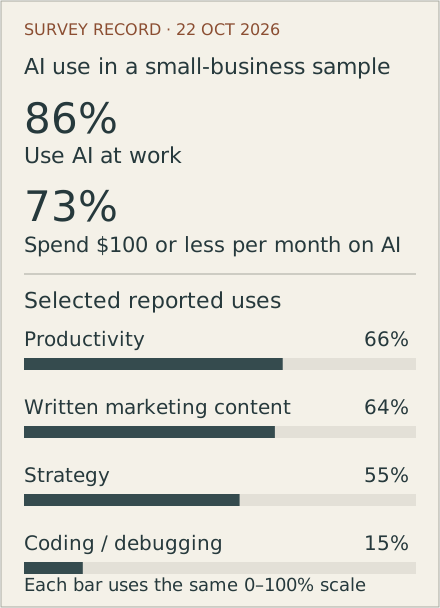
Survey record · 22 October 2026. 2,474 respondents · Goldman Sachs’ 10,000 Small Businesses program.
Regional observations
- Washington, D.C. area: 88% use AI; 12% of AI users pay nothing.
- Texas: 86% use AI; marketing copy is the leading use.
- Florida: 93% use AI; 69 respondents.
- New York City region: 65% of AI users spend $100 or less per month.
Program participants, rather than a sample of all small businesses. Regional samples are smaller; the Florida result is based on 69 respondents.
Data: Goldman Sachs, as reported by Axios · read the report.
XO: The caveat that matters: the sample is 2,474 graduates of Goldman’s 10,000 Small Businesses program — people who sought out business training — not small businesses at large, and the state slices are small. Axios also issued a correction, softening “fully integrating” to “using.”
Why it’s worth your attention: it’s a picture of a market that has adopted AI as a $100/month writing-and-notes tool — almost nobody is paying for an agent, and coding is the least-used application. That’s the gap LatentWinds is pointed at: systems that meet people in their workplace, not a chat box that drafts the newsletter. It’s also the audience for the system document’s public edition — people who’ll need the glossary.
Captain: you are right to notice, this is a self-selected group of businesses that are aggressive in their approach. What I don't see is any kind of reworking the business model to take advantage of the deep capabilities of current agents
XO: Right — and the survey's own categories give it away. "Productivity," "written content," "strategy" are all task substitution: the same business, same workflow, with a faster typist. Nobody in that survey is reporting "we changed what the business is because the agent can now do X." Even the 15% coding figure is probably someone fixing a Squarespace snippet.
Captain: Yeah, this is also an issue that's being swept into the corner, all attention is on getting to market and establishing self-serving conventions which worries me.
XO: A few reasons I think that's structural rather than a lag the next model fixes:
The $100 ceiling is the tell. At that price you're buying one seat on a chat product. Re-architecting a business around agents means something that runs when you're not watching, holds state, touches your real systems, and can be trusted to do so — and that costs more than $100 a month before you've paid for a single token, because the expensive part is the harness and support system, not the model. The survey population has found the cheap, safe, bounded thing and stopped there, which is rational given what's on offer to them.
The reworking requires a kind of operator they don't have. You spent weeks learning to "speak agent," and you came in with Kubernetes and GitOps and a lifetime of systems thinking. The owner of a 12-person landscaping company is not going to build a fleet. The reworking has to arrive as a product that already embodies the discipline — the bounds, the receipts, the refusal-on-evidence — so the owner gets the agentic capability without having to invent the governance. That is the Latent Winds thesis, more or less verbatim.
Trust is the actual bottleneck, and the fly-by-night systems are poisoning it. An owner who has watched one "autonomous agent" demo quietly do something wrong will go back to the $100 chat box and never leave. Which is exactly why "a strong and safe way to develop with agents" is a hard sell and the only sell that lasts. The Awakener work — grants, bounds, no credential leaving the seat, a receipt for everything — isn't a nice-to-have for this audience; it's the precondition for any of them ever reworking anything.
Most businesses have adopted AI the way they adopted spell-check. The interesting work starts when you let it change what the business can do — and that only happens when you can trust it unattended.